15 bend channels
4 stretch channels
Data is the bottleneck of Physical AI. Capturing it shouldn't cost like a lab.
Every capture method fails somewhere.
Usually at grasping.
A serious data operation needs three things at once: accuracy you can trust as ground truth, continuity through hours of real manipulation, and a per-seat cost that scales to fleets. Grasping is occlusion — and every lost track is a retake.
A soft glove. A wearable camera.
Nothing else.
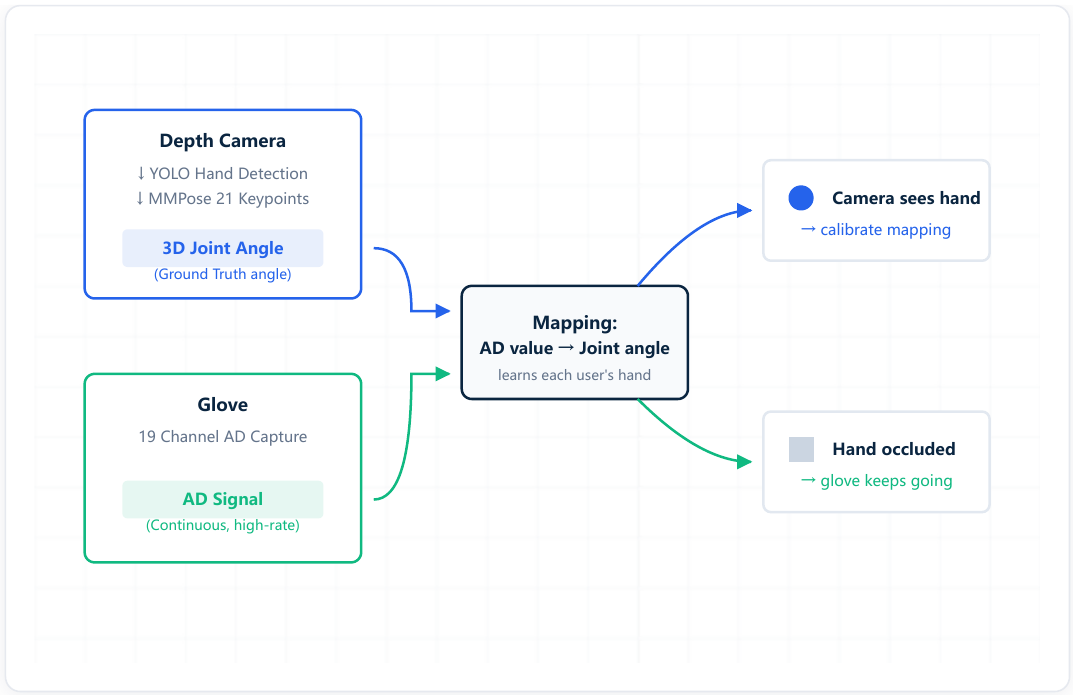
Vision tells you where the hand is. The glove tells you what it's doing — even when the camera can't see it. The two cover each other's blind spots.
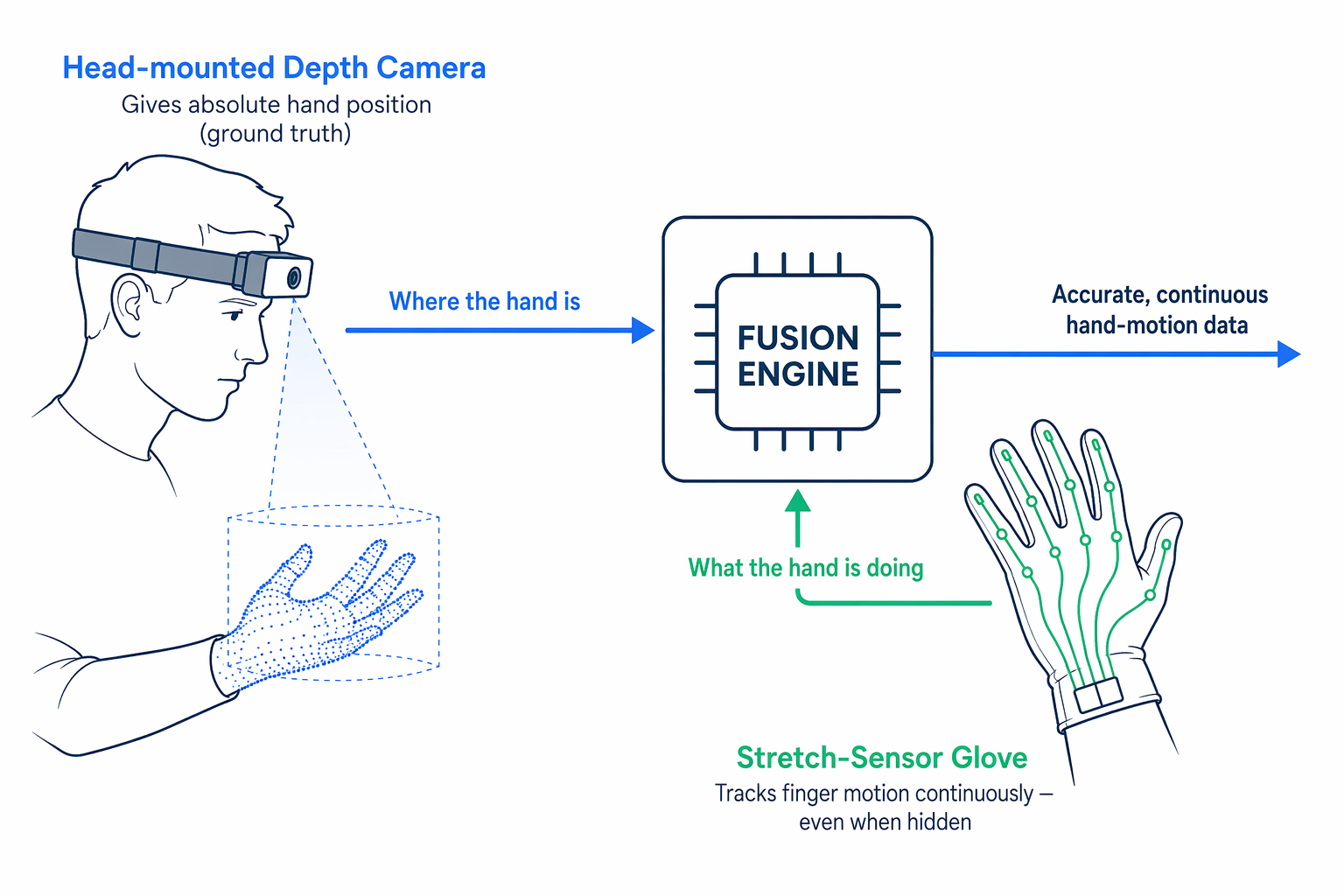
Vision anchors · glove never blinks
Absolute when visible.
Continuous when not.
A head-mounted depth camera provides absolute posture: 21 keypoints are regressed, and depth back-projection recovers true 3D joint angles. Meanwhile the glove streams 19 channels of sensor data and calculates 20+ DOFs on each hand — continuously, whatever the camera sees.
Time-synced capture
Vision computes true 3D joint angles while the glove captures raw values on every channel, time-synced.
Paired sampling
Whenever vision locks a joint cleanly, the system logs a paired sample: visual angle + sensor value.
Per-hand mapping
Samples build a per-channel fit from sensor value to joint angle — tuned automatically to each operator's hand.
Occlusion-proof output
Vision keeps applying local corrections; when the hand is hidden, the glove carries the motion on its own.
Calibrate only when vision is trustworthy.
A visual angle becomes a calibration sample only when keypoint confidence is high. Our cutting edge opportunistic recalibration mechanism cancels drift for each single joint so the full hand never needs to be visible at once.
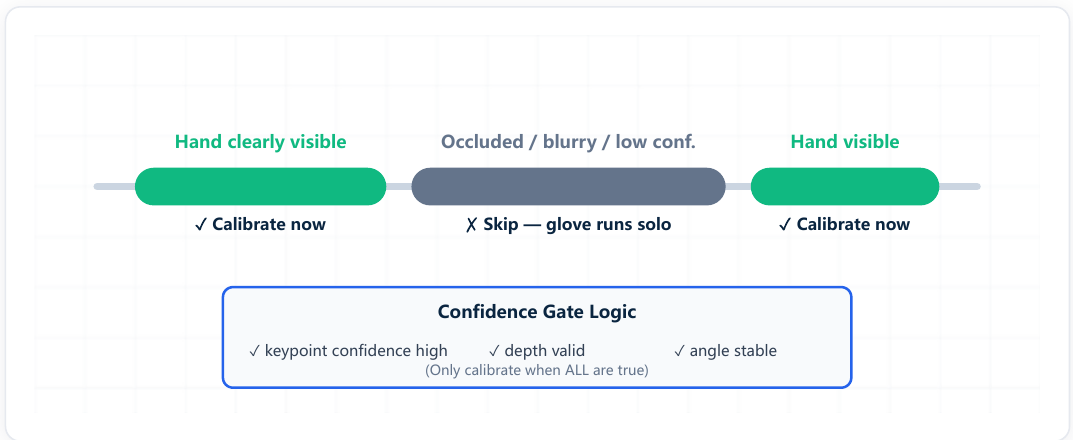
Confidence gate · calibrate only on clean frames
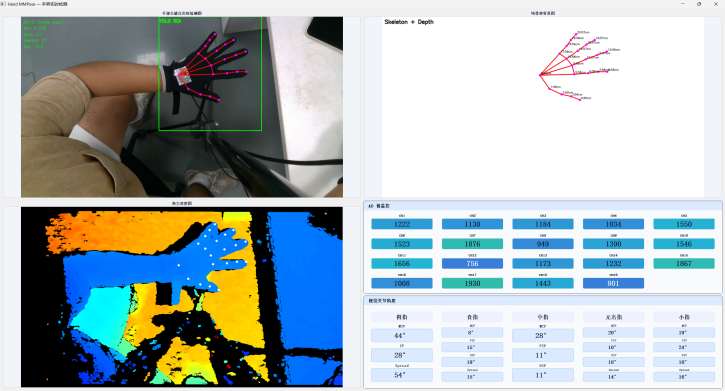
Live capture
Skeleton lock, depth field, and 19 channels streaming — per-joint angles in real time.
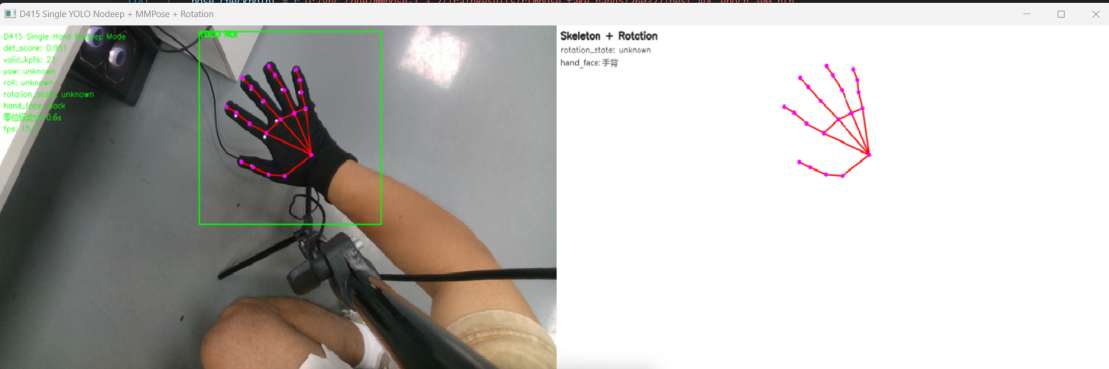
Robust on gloved hands
A skin-toned glove plus high-contrast joint markers keeps keypoint accuracy at ≈ 0.95–0.98 after transfer learning.
Tested, not promised.
Lab-grade accuracy at tool-grade cost — verified against professional optical mocap and cycled to failure on automated rigs.
Mean fingertip error (mm) · lower is better
Public depth-based benchmarks are dominated by fast motion, severe self-occlusion, and ambiguous frames. Our calibration samples are taken precisely when those conditions are absent.
500,000+ cycles on the rig.
No issue.
Sensor elements were cycled to 20%+ elongation half a million times on an automated endurance rig. The glove maintains stable, continuous and accurate output. Our vision system continuously calibrates the sensors in real time, ensuring every captured motion is as accurate as the very first.
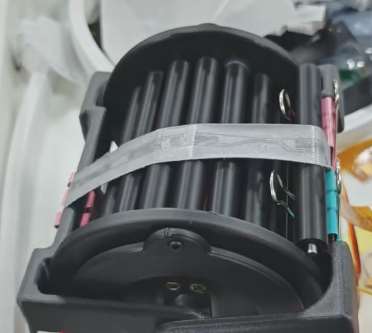
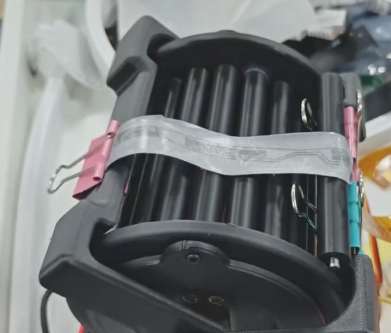
Endurance & repeatability
| Bending cycles (20% elongation) | 500,000+ |
|---|---|
| Repeat-bend reproducibility (glove sensor level) | ±2% |
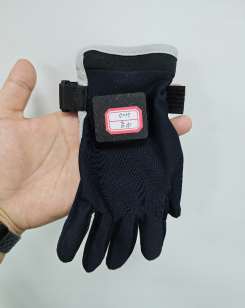
Soft, ultra-thin, no exoskeleton
Operators move naturally and collect through a full shift without fatigue.
Interference-free by design
Resistive channels drop no frames under occlusion, changing light, or electromagnetic noise.
Scale to hundreds of operators,
no mocap studio required
Built to scale
Glove plus one commodity depth camera — a cost structure built for fleet-scale collection, not a calibrated capture volume.
Never blinks
Hands buried in a bin, wrapped around a tool, out of frame — the data keeps flowing. No retakes, no gaps in the dataset.
Tactile-ready
The platform natively hosts tactile arrays. Posture capture today extends to posture-plus-force tomorrow — same glove, same pipeline.